Welltory ELC · Data + code + physiology
When your heart rate climbs just walking to the car - making sense of the METs number
Some of you living with MS, hypermobility or fibromyalgia have asked us whether a high METs reading can mislead, and which metric to trust for movement when your step count sits below the guidelines while everything else looks fine. We took the question into the algorithm’s code, our own community data, a comparison with a healthy reference, and the research.
For the Welltory ELC community · 2026-06-10 · Long COVID / ME/CFS / fibro / POTS
Shared with the Welltory ELC community · general information, not a substitute for medical advice
A question from the community
Can MET-based activity estimates be misleading when heart rate rises from low-intensity everyday tasks like grocery shopping or walking from a car to a shop? How should METs, step count, and other metrics be weighed against each other as indicators of movement, especially when step count is low but other metrics look fine?
The short version
If you only have energy for one page
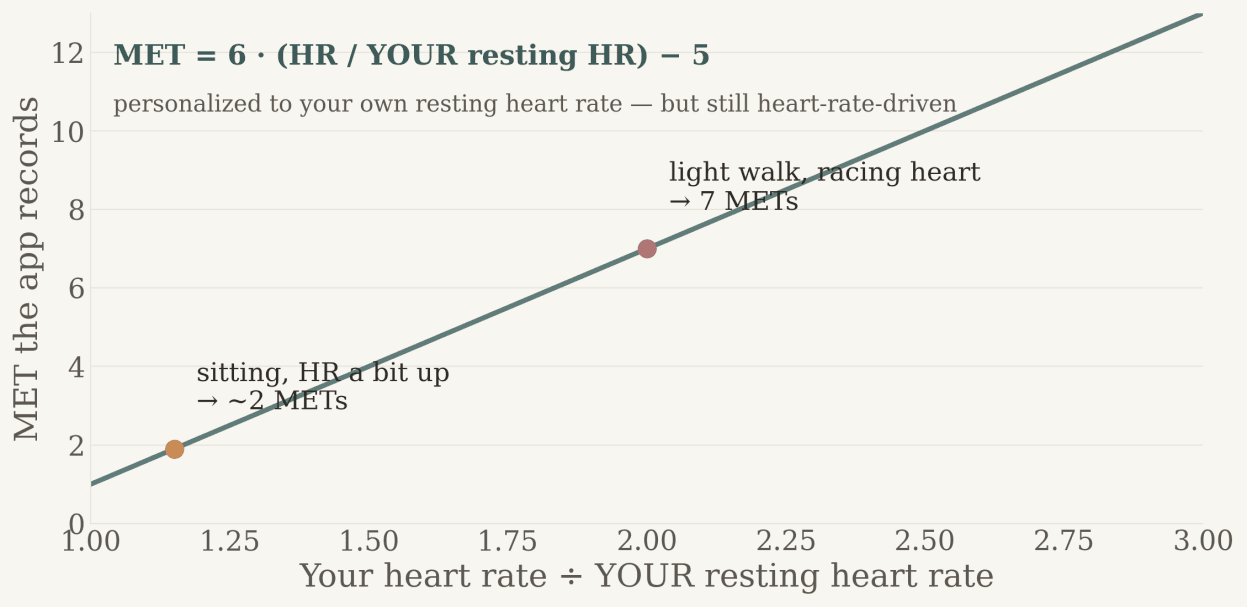
Yes — a high METs number can over-state things for bodies like ours. METs are personalized to you, but they are still built on heart rate. In MS, hypermobility, fibromyalgia and POTS the heart speeds up to compensate — for blood pooling, or an over-active fight-or-flight branch — not because you worked hard. So a moment of racing heart reads as more intensity than it really was.
Step count is not the right yardstick either. It mostly reflects how easily you can move around. Steps below the usual guidelines are expected here — not a personal failing.
The steadier things to lean on are a personal heart-rate ceiling to stay within (a limit, not a target), how your body recovers afterwards (heart rate settling, how you feel the next day), and for hypermobility, joint stability.
A weaker guide for many of us
Step count
reflects mobility / disability
Better guides for bodies like ours
Personal HR ceiling
a limit to stay within, not a target
Recovery
HR settling, next-day symptoms
Joint stability (hEDS)
proprioception, symptom response
The rest of this note shows how we got here. Read whichever parts you have energy for, and skip the rest.
Step 1 · What a MET actually is
A personalized number — but built on heart rate
In the code, a MET is computed from heart rate relative to your own resting rate: MET = 6 · (HR / your resting HR) − 5. So it is already personal — the same beats-per-minute means a different MET for two different people. But the raw signal underneath is still heart rate.
Step 2 · The number is more personalized than it looks
Welltory already adapts METs to you on four layers
It is fair to say the METs number is not a crude absolute. The code personalizes it: it divides by your resting heart rate, scales the intensity zones to your own aerobic ceiling, lets those zones drift up or down as your fitness changes, and offers a pacing mode where light activity counts as beneficial.
Welltory already personalizes METs on four layers
1 · Divided by YOUR resting HR
same beats/min = different MET
for different people
2 · Zones scaled to YOUR max
'moderate' for a 10-MET ceiling
is not 'moderate' for a 20-MET one
3 · Zones adapt over time
fitter → thresholds rise;
detrained → they fall
4 · Pacing mode
light activity counts as
beneficial; sedentary stress split off
Step 3 · In our community
Most elevated heart rate here is not movement
Across 79 of our ELC members and 27,585 days, the majority of elevated-heart-rate time is spent sitting or standing still — Welltory’s harmful sedentary stress, which is already separated from movement in the zones.
60% HR up while NOT moving — of elevated-heart-rate minutes in OUR community
And the step count doesn’t capture the physiology. Within each member, steps barely track intensity, autonomic load, or aerobic ceiling.
Step 4 · Our community vs a healthy reference
As a community, we run hotter at rest, with a lower ceiling and fewer steps
Comparing 79 of our ELC members against 24 general Welltory users without a chronic condition, three things separate them — and the first one feeds the MET formula directly.
Resting heart rate (bpm)
Aerobic ceiling (max MET)
Steps per day
Healthy reference = 24 general Welltory users without a chronic condition · OUR community = 79 ELC members (lake)
+9 bpm
higher resting HR (ours)
−12%
lower aerobic ceiling
−47%
fewer steps/day
Step 5 · Why bodies like ours run hot
Hypermobility, fibromyalgia, MS and POTS share one autonomic thread
A fair question many of you have asked: is heart rate really linked to hypermobility, or to fibromyalgia. It is — and the link is the same thread that ties this whole cluster together. The autonomic nervous system, which sets heart rate and blood-vessel tone in the background, tends to run off-balance across these conditions, usually tilted toward fight-or-flight. The heart often speeds up to compensate for blood pooling or low vessel tone, not because of effort.
Why bodies like ours run hot: one autonomic thread connects the whole cluster
Hypermobility / hEDS
stretchy vessels → blood pools on standing; small-fibre nerve changes
→ heart speeds up to compensate
Fibromyalgia
fight-or-flight branch runs high even at rest
→ higher resting HR, lower HRV
Multiple sclerosis
nerve signals to vessels & heart can be disrupted
→ orthostatic intolerance ~50%
The shared thread
the autonomic nervous system
running off-balance (dysautonomia)
POTS
its defining feature: HR jumps ≥30 bpm on standing
→ compensatory, not exertion
ME/CFS & Long COVID
widespread autonomic strain, low blood flow on standing
→ racing heart, post-exertion crashes
A little more on each, in plain terms:
Hypermobility / hEDS. Stretchier connective tissue lets blood pool in the legs on standing, so the heart speeds up to keep blood moving; small-fibre nerve changes add to it. Orthostatic intolerance shows up in roughly 7 in 10, and a postural heart-rate jump in about 4 in 10 (de Wandele 2016; Igharo 2022).
Fibromyalgia. The fight-or-flight branch tends to run high even at rest — faster resting heart rate, lower heart-rate variability, and a harder time tolerating standing (Martinez-Lavin 1998; Furlan 2005).
Multiple sclerosis. The nerve signalling that steadies blood vessels and heart rate can be disrupted; orthostatic intolerance affects around half, and tracks with fatigue (Findling 2020; Flachenecker 2003).
POTS, which often overlaps the others, is defined by a heart-rate jump of 30+ bpm on standing — compensatory, not exertion (Mathias 2011; Chopra 2026).
They travel together because they share this autonomic strain — ME/CFS, Long COVID and hEDS show strikingly overlapping autonomic profiles (Novak 2026; Martinez-Martinez 2014).
Step 6 · And why heart rate is an imperfect stand-in for effort
The heart-rate–oxygen link that METs assume is exactly what these conditions bend
The MET formula works because, in healthy people, heart rate tracks oxygen use along a stable line. That assumption is what MS, dysautonomia and deconditioning break.
The equation our app uses is the published Heart-Rate-Index VO₂ estimate, validated on healthy exercise testing (Wicks 2025).
When disease alters the heart-rate–oxygen relationship, heart-rate-based MET estimates become inaccurate — shown directly after stroke, a close analogue (Cataldo 2024).
The heart-rate–energy line varies enormously between people, so individual readings need personal calibration (Schrack 2014).
In POTS the racing heart on standing is largely compensatory — defending blood flow, not doing aerobic work (Chopra 2026).
For steps: in MS they mostly reflect mobility and disability (Goldman 2025); wrist trackers measure steps and active-minutes poorly in MS (Lavelle 2022); the ~8,000-step targets come from mostly-healthy cohorts (Master 2022).
Step 7 · So what is the better guide
Not a single number — and not steps
If METs personalize the yardstick but still ride on heart rate, and steps reflect disability, the useful signals for bodies like ours are about how your body handles movement, read against your own baseline.
A weaker guide for many of us
Step count
reflects mobility / disability
Better guides for bodies like ours
Personal HR ceiling
a limit to stay within, not a target
Recovery
HR settling, next-day symptoms
Joint stability (hEDS)
proprioception, symptom response
The answer
Further reading
If you would like to go deeper, these are readable starting points (most have a free abstract):
- 1.Aziz, Q., Harris, L. A., Goodman, B. P., Simrén, M., & Shin, A. (2025). AGA clinical practice update on GI manifestations and autonomic or immune dysfunction in hypermobile Ehlers-Danlos syndrome: Expert review. *Clinical Gastroenterology and Hepatology, 23*(8), 1291–1302. https://doi.org/10.1016/j.cgh.2025.02.015
- 2.Cataldo, A. R., Fei, J., Hutchinson, K. J., Sloutsky, R., Starr, J., De Rossi, S. M. M., & Awad, L. N. (2024). Enhancing heart rate-based estimation of energy expenditure and exercise intensity in patients post stroke. *Bioengineering, 11*(12), Article 1250. https://doi.org/10.3390/bioengineering11121250
- 3.Chopra, P. (2026). Postural orthostatic tachycardia syndrome: When dysautonomia misleads: A mechanistic argument for compensatory orthostatic tachycardia. *Frontiers in Neurology, 17*, Article 1806502. https://doi.org/10.3389/fneur.2026.1806502
- 4.de Wandele, I., Rombaut, L., De Backer, T., Peersman, W., Da Silva, H., De Mits, S., De Paepe, A., Calders, P., & Malfait, F. (2016). Orthostatic intolerance and fatigue in the hypermobility type of Ehlers-Danlos syndrome. *Rheumatology, 55*(8), 1412–1420. https://doi.org/10.1093/rheumatology/kew032
- 5.Findling, O., Hauer, L., Pezawas, T., Rommer, P. S., Struhal, W., & Sellner, J. (2020). Cardiac autonomic dysfunction in multiple sclerosis: A systematic review of current knowledge and impact of immunotherapies. *Journal of Clinical Medicine, 9*(2), Article 335. https://doi.org/10.3390/jcm9020335
- 6.Flachenecker, P., Rufer, A., Bihler, I., Hippel, C., Reiners, K., Toyka, K. V., & Kesselring, J. (2003). Fatigue in MS is related to sympathetic vasomotor dysfunction. *Neurology, 61*(6), 851–853. https://doi.org/10.1212/01.WNL.0000080365.95436.B8
- 7.Furlan, R., Colombo, S., Perego, F., Atzeni, F., Diana, A., Barbic, F., Porta, A., Pace, F., Malliani, A., & Sarzi-Puttini, P. (2005). Abnormalities of cardiovascular neural control and reduced orthostatic tolerance in patients with primary fibromyalgia. *The Journal of Rheumatology, 32*(9), 1787–1793.
- 8.Martínez-Lavín, M., Hermosillo, A. G., Rosas, M., & Soto, M. E. (1998). Circadian studies of autonomic nervous balance in patients with fibromyalgia: A heart rate variability analysis. *Arthritis & Rheumatism, 41*(11), 1966–1971.
- 9.Mathias, C. J., Low, D. A., Iodice, V., Owens, A. P., Kirbis, M., & Grahame, R. (2011). Postural tachycardia syndrome—Current experience and concepts. *Nature Reviews Neurology, 8*(1), 22–34. https://doi.org/10.1038/nrneurol.2011.187
- 10.Roma, M., Marden, C. L., De Wandele, I., Francomano, C. A., & Rowe, P. C. (2018). Postural tachycardia syndrome and other forms of orthostatic intolerance in Ehlers-Danlos syndrome. *Autonomic Neuroscience, 215*, 89–96. https://doi.org/10.1016/j.autneu.2018.02.006
- 11.Schrack, J. A., Zipunnikov, V., Goldsmith, J., Bandeen-Roche, K., Crainiceanu, C. M., & Ferrucci, L. (2014). Estimating energy expenditure from heart rate in older adults: A case for calibration. *PLOS ONE, 9*(4), Article e93520. https://doi.org/10.1371/journal.pone.0093520
- 12.Wickens, B., Leeming, H., Dickinson, K., McBurney, E., Leslie, K., Bull, M., & Hilliard, N. (2025). Pacing with a heart rate monitor for people with myalgic encephalomyelitis/chronic fatigue syndrome and long COVID: A feasibility study. *Fatigue: Biomedicine, Health & Behavior, 13*(1), 74–96.
Evidence and limits
Our community data: 79 ELC members, 27,585 user-days (day_info). Healthy reference: 24 general Welltory users without a chronic condition (golden_set), zero overlap with our members. Algorithm: Welltory code (MET = 6 times HR/resting-HR minus 5; zones scaled to personal maxMET). Comparable metrics: steps, resting HR, aerobic ceiling. Descriptive only; the two cohorts differ in more than illness. This is general information from our community’s data — please bring any movement decisions to your own clinician.
Welltory ELC Community · shared for understanding, not a substitute for medical advice