Welltory ELC · Data + code + physiology
When the Health score crashes, is the body warning us?
A member watched her Health score fall from 100% to 20% and asked whether it signals a coming crash. Following that question led through our community data, into the algorithm’s source code, and out into the autonomic-nervous-system literature. This is the trail.
Prepared 2026-06-10 · R&D analysis · Women with PEM (Long COVID / ME/CFS / fibro / POTS)
Health score is per-user normalized — never compared across people
A question from the community
Can a sharp drop in the Health score — for example from around 100% to 20% — serve as a signal of elevated physiological stress? The app often interprets a drop like this as a sign of getting sick — does the literature or observational data suggest it may also correlate with an oncoming crash (post-exertional collapse)?
The short version
If you only have energy for one page
A drop in your Health score is a mirror of how your body is doing right now — not a reliable warning that a crash is coming. It is the metric working as designed: an early illness detector. In PEM, being “off” from your healthy baseline is so common that the alarm is true almost every day.
As a warning ahead of a crash, it is mostly false alarms. In our community a drop fires on about 1 day in 4, and is actually followed by a crash only about 5% of the time. It does not fall sharply before a crash — it sits low throughout.
What did come before crashes more reliably was a spike in activity the day before. And your own sense of feeling off carried the clearest signal on the day itself.
5 real warnings · 95 false alarms — out of every 100 ‘drop’ flags
The rest of this note shows how we got here. Read whichever parts you have energy for, and skip the rest.
Step 1 · Split the question
“Warning” and “mirror” are not the same claim
The question quietly bundles two ideas. A number that only drops once a person already feels sick is a mirror of the present. A real warning would drop before the feeling — early enough to act. Everything downstream depends on telling these apart, with the PEM lag of 24–72 hours in mind.
A drop in the score
two different claims
MIRROR
moves WITH feeling sick
→ already a symptom
EARLY WARNING
drops BEFORE the crash
→ buys you time
Step 2 · Watch the number move
It behaves like a switch, not a dial
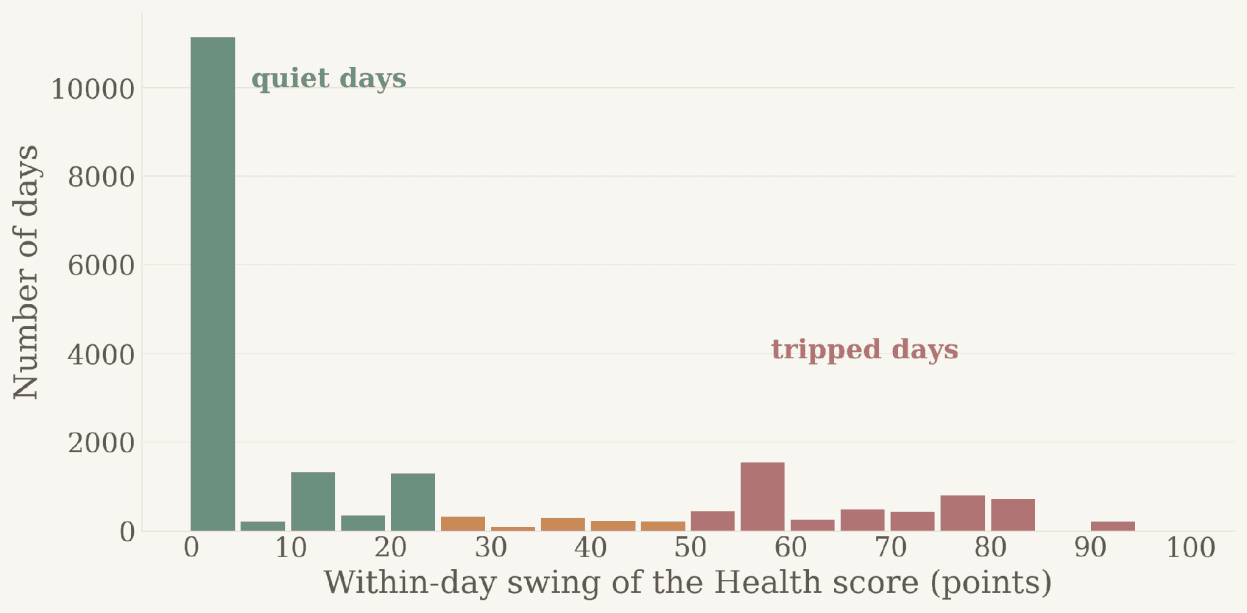
Across 84 members and 20,324 days, the dramatic swing is real: 24.1% of days swing by 50+ points. But the number does not glide. On half of all multi-measurement days it does not move at all, then it jumps — quiet, or tripped.
Step 3 · Does the drop mean anything?
In our community, the drop is a mirror — and a noisy one
Three checks, all within-person, against each member’s own baseline. First: does the swing line up with a crash that day. The big swing itself has essentially no link (1.01×). What does line up is a low level, especially the daily morning score.
Second: does the swing track how she feels. Barely — the within-person correlation with self-reported wellbeing is ρ ≈ +0.01, essentially zero. Third, and the real question: does it warn ahead. When a swing fires in the 1–3 days before a crash, it is right only about 5% of the time. It fires on a quarter of all days, so it “catches” crashes only by crying wolf constantly.
5 real warnings · 95 false alarms — out of every 100 ‘drop’ flags
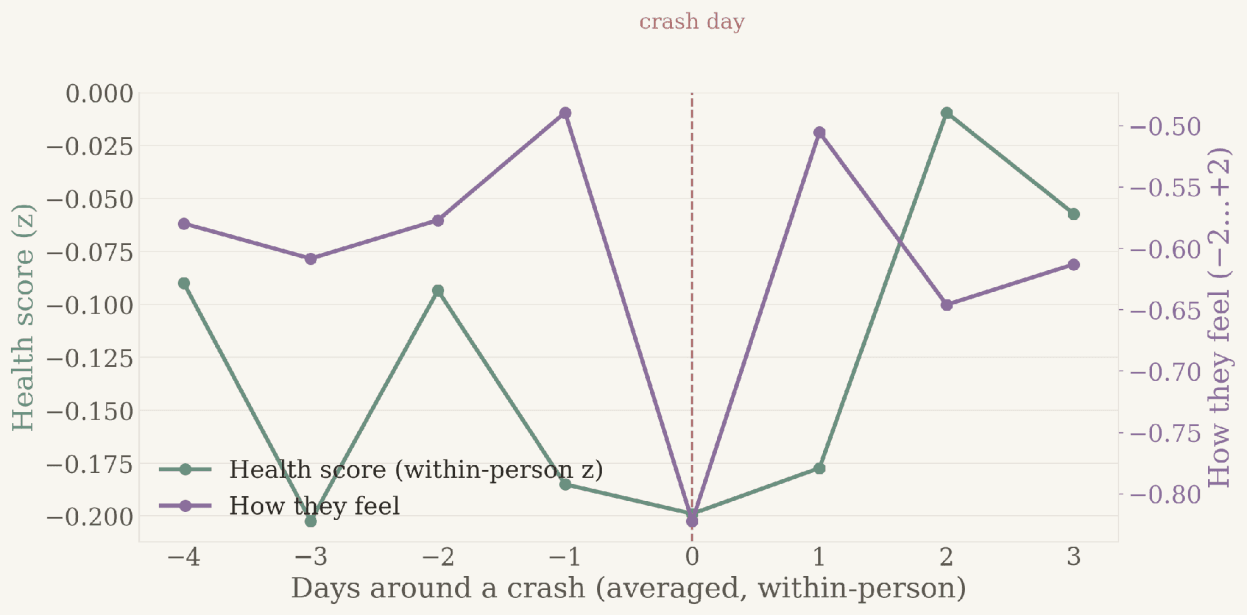
Lining up every crash tells the same story: the score sits in a shallow dip the whole time — it does not plunge sharply before. The cleaner signal is what people say; felt state drops hardest on the crash day itself.
Step 4 · Step back — what is this number?
It was built to stay flat in healthy people
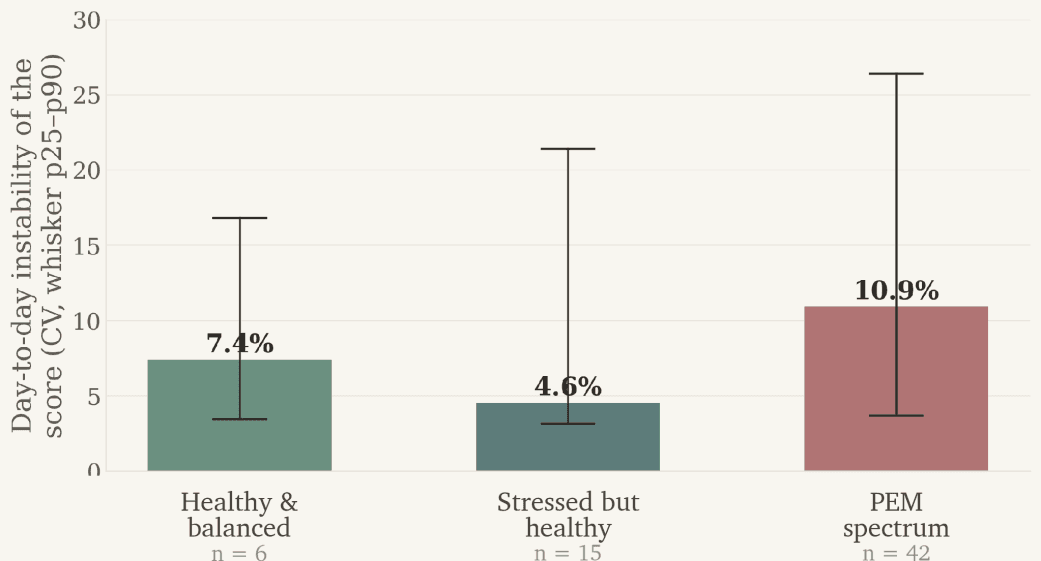
If the drop is not forecasting crashes, what is it doing. Across 97 reference users the score sits at a median of 94/100 and barely moves. People who are stressed and anxious but not chronically ill stay the most stable of all. Stress does not move this number. Illness does.
94
population median (near ceiling)
4.6%
instability — stressed-healthy
10.9%
instability — PEM spectrum
4×
more big drops in PEM
Step 5 · Open the box
What the score actually measures
The source code settles it. The number watches two things — how “tense” the heart rhythm is (a sympathetic marker, AMo) and how much “recovery” tone it carries (a vagal marker, pNN20 / RMSSD) — and grades them against both the person’s own recent norm and a healthy population norm for their age and sex. By default the answer is 100. It falls only when tension is high and recovery is low at once.
AMo ▲
sympathetic "tension"
pNN20 / RMSSD ▼
vagal "recovery"
compared to
your 5–30d norm
+ healthy pop. by age/sex
Score = 100
by default — falls only when tension high AND recovery low
The daily score multiplies three such checks — any one failing pulls it all down:
baseline
vs healthy pop.
recent trend
acute drop vs your week
anomalies
odd readings in 24h
Step 6 · Why PEM trips it constantly
The detector is firing on real biology
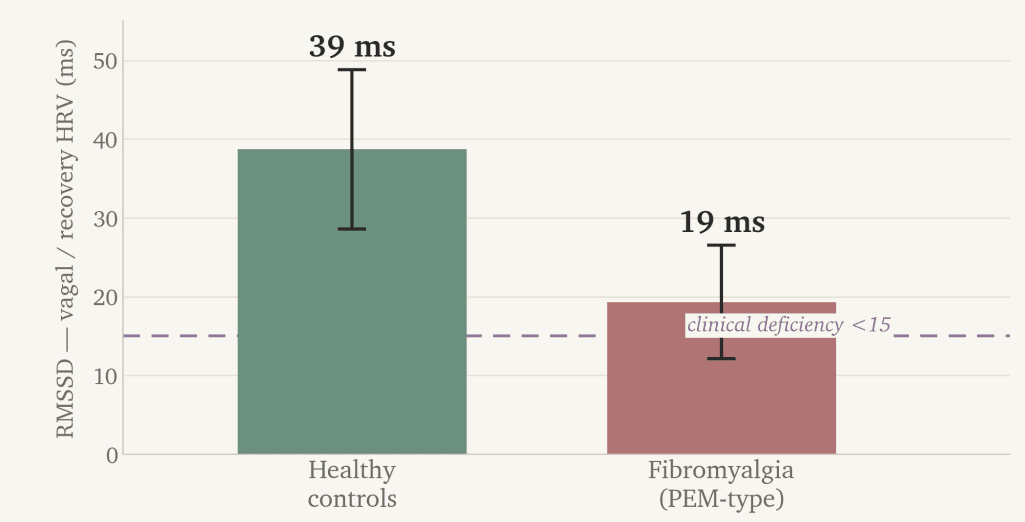
PEM and related conditions hit exactly the two dials the score watches. Vagal recovery tone (RMSSD) is roughly halved versus healthy — in fibromyalgia it sits near the clinical-deficiency line.
There is a deeper point. Healthy autonomics keep a moderate complexity — flexible, neither rigid nor chaotic. In PEM that adaptive middle is lost: the system either stiffens or lurches erratically. Both extremes register as “deviation”, which is exactly what trips the score’s trend and anomaly checks, over and over. In our own cohort this shows as lost complexity (entropy effect size −0.75) and autonomic rigidity (+0.74).
Healthy autonomics sit in the middle. PEM is pushed to either edge — both read as ‘deviation’.
What this means
Evidence and limits
Community data: 84 members, 20,324 user-days, 149 crash episodes (per-measurement health_percent). Reference cohort: Welltory 10-personas handoff (100 users × ~89 days of the daily morning score). Algorithm: Welltory code (welltory_cardio_hrv). Physiology: internal research vault plus phenotyping benchmarks.
This is descriptive work on small groups; no inferential claims are made. The field has no validated condition-specific HRV norms for ME/CFS, Long COVID or POTS — the strongest quantitative anchor is fibromyalgia, so the claims rest on direction, not precise cut-offs. The Health score is normalized per user and is never compared between people.
Welltory ELC · not a substitute for medical advice